Showing posts with label Acids and Bases. Show all posts

Wednesday, February 10, 2016

Molar Mass of an Unknown Acid

Today my lab partner and I finished our Molar Mass of an Unknown Acid lab. This lab was another titration, however, it was different from the last one in that we didn't know what the acid was in the second titration. Using KHP to standardize, we were able to calculate the molar mass of the unknown acid. After performing the titrations of the KHP and the unknown acid, we then calculated the molar mass of KHP. Once the average molarity was found, we were able to convert it to moles of the unknown acid using the volume of NaOH used, the average molarity of KHP, and the mole to mole ratio. With the moles of the unknown acid we were able to use it as the divider of the mass of the unknown. In dividing the mass by the moles, we were able to calculate the molar mass as 164.76 g/mol.


The unknown acid at its equivalence point

This link helped with the calculations for this lab

Friday, February 5, 2016

Percent Acetic Acid in Vinegar Lab


Over the last few days my lab partner and I have performed the Percent Acetic Acid in Vinegar lab. By standardizing a solution of NaOH with the acid potassium hydrogen phthalate, or KHP, in a titration we were able to determine the molarity of the NaOH solution. Using this standard NaOH solution, we were also able to determine the percent of acetic acid, HC2H3O2 in commercial vinegar.


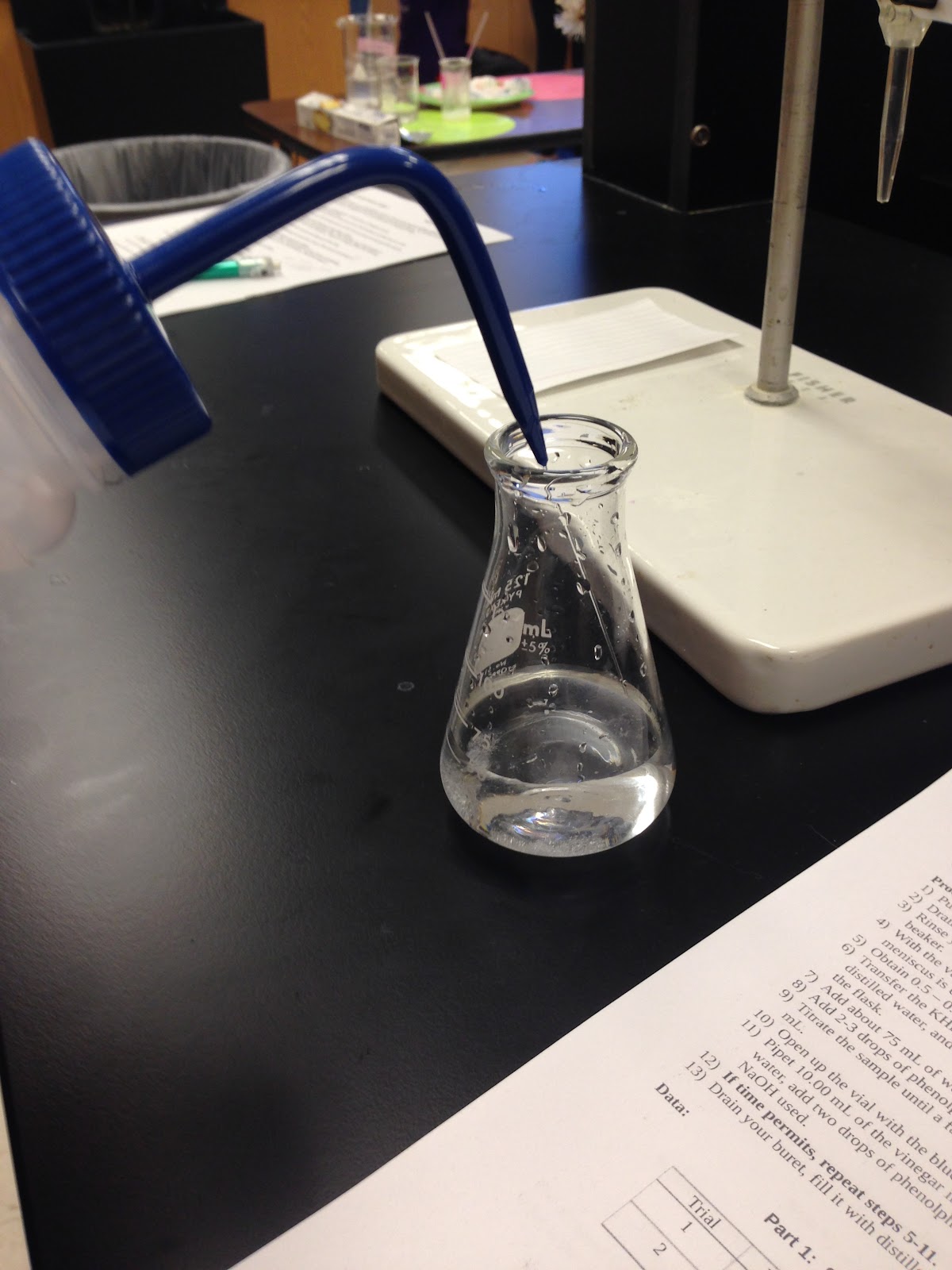
Adding distilled water to the Erlenmeyer flask in order to dilute the vinegar


After adding two drops of the indicator phenolphthalein we were able to titrate the solution


After all of the titrations were complete, the calculations for the percent acetic acid in vinegar could be made by calculating the average molarity of NaOH and plugging that in to find the molarity of the acetic acid. The molarity could then be multiplied by the molar mass in order to find the mass of solute in the solution. With this mass the percent acetic acid in vinegar can be determined by dividing it by the volume of the solution.

This was helpful in calculating the percent acetic acid in vinegar

Wednesday, February 3, 2016

Titrations

Today's lecture in chemistry was over titrations and equivalence points. A titration is a technique that is used in order to determine the concentration of an unknown acid or base. During the titration, a neutralization reaction, or a reaction that uses equal quantities of acid and base, occurs. A neutralization reaction is reached once the amount of acid and base, with respect to concentrations, are equal and this can be seen when the solution in the Erlenmeyer flask turns a light pink. This change in color is caused by an indicator that is pH sensitive which changes the color once the reaction is complete. An equivalency point in a titration is when the moles that were originally in the solution are equal to the moles after the titration.


A titration is shown in this picture above. the base is in the buret, being kept there by the stopcock. The Erlenmeyer flask contains the acid which has an unknown concentration, this flask is placed right under the buret. The stopcock is then opened in order to allow the base to go into the acid until the color change occurs.

I found this site helpful in order to practice some titration calculations

Friday, January 29, 2016

Hydrogen Concentration, Hydroxide Concentration, pH, and pOH

Today we learned how to convert between hydrogen concentration, hydroxide concentration, pH and pOH. We were able to convert between all of these using one original given value.
 This picture shows how to get from each value to the next in simple problems.


A sample problem from our notes looked like this:
What is the pH of a solution that is 12.5 M HCL?
pH= -log [H+]
     = -log(12.5)
     = -1.097
In order to solve this problem you have to look at the given information. Since we were given the concentration of Hydrochloric acid, it is the same as being given the concentration of hydrogen ions (acids go with hydrogen, bases go with hydronium). Using the chart, we know that in order to get to the pH with the concentration of hydrogen ions we need to do -log [H+].

Other problems require more than one step in order to get the answer. For example, if you are given the concentration of hydronium ions and asked to find the pH, then you need to find the concentration of hydrogen ions, or the pOH first.

This site helped me practice the conversions from this lecture.

Thursday, January 28, 2016

Strength of Acids and Bases

Today's lecture was over determining if the salt produced in an acid-base reaction is acidic, basic, or neutral. In order to determine this we have to look at the strength of the parent acid and parent base. When a reaction includes a strong parent acid and strong parent base, the resulting salt is neutral. Likewise, a weak parent acid and weak parent base produces a neutral salt. On the other hand, a strong parent acid and a weak parent base result in an acidic salt, and a weak parent acid and strong parent base produce a basic salt.


In order to determine if the parent acid and parent base are weak or strong you need to know the rule. For acids, the strength is determined by how many oxygens the compound contains. If the oxygen outnumbers the hydrogen present in the compound, then it is a strong acid. Important exceptions to this rule can be found in the acronym BrINCl, pertaining to acids that contain Bromine, Iodine, Nitrogen, and Chlorine. In order to determine if a base is strong or weak, you need to check if the cation is in group 1 or group 2 of the elements. If the cation is in group 1 or group 2 on the periodic table, then it is a strong base and any other cations mean a weak base.

I found this video helpful in remembering how to determine if the acid and base are strong or weak.

Wednesday, January 27, 2016

Acids vs. Bases

In class today we learned about the differences between acids and bases in physical properties and how they were defined by two different scientists, Arrhenius and Bronsted-Lowery.
Physical properties:
Acids                                    Bases
Taste sour                             Taste bitter
Feel sticky                            Feel slippery
Turns litmus pink                 Turns litmus blue

Arrhenius vs. Bronsted-Lowery

Arrhenius
Acids are those species that produce hydrogen ions in solution (H+)
Bases are those species that produce hydroxide ions in solution (OH-)

Bronsted-Lowery
Acids are those species that donate a proton (H+)
Bases are those species that accept a proton (OH-)

We also learned how to determine the conjugate base and conjugate acid in a reaction. By determining the acid and base using either the Arrhenius or Bronted-Lowery definitions, we can then find its conjugate base and conjugate acid. A conjugate acid is the substance that forms when a proton is added to a base. On the other hand, a conjugate base is the remaining substance when a proton is lost from an acid.

This Link has some helpful practice problems for acids bases.