In redox reactions, electrons are transferred from the metal to the non-metal. If a species loses electrons it is oxidized; whereas, if a species gains electrons it is said to be reduced. An easy way to remember the difference between oxidation and reduction is OIL RIG. OIL RIG stands for Oxidation Is Loss and Reduction Is Gain, applying to the transfer of electrons that takes place during these reactions. The species that is oxidized in a redox reaction is also called the reducing agent. Similarly, the specie that is reduced in a redox reaction is also called the oxidizing agent.
Single-replacement
In a single-replacement reaction, the metals in the reactants change places. These reactions are based on reactivity series which show metals from most reactive to least reactive.
Synthesis
A synthesis reaction occurs when two or more reactants form one product.
Decomposition
Decomposition is a reaction in which one reactant produces two or more products.
Combustion
When a hydrocarbon reacts with oxygen in order to always produce carbon dioxide and water, it is a combustion reaction.
I found This to be helpful in practicing redox reactions
Some practice for Classifying reactions was helpful as well
These Practice Redox problems were beneficial in understanding this concept as well
Showing posts with label Chemical Reactions. Show all posts
Showing posts with label Chemical Reactions. Show all posts
Friday, December 4, 2015

Wednesday, December 2, 2015
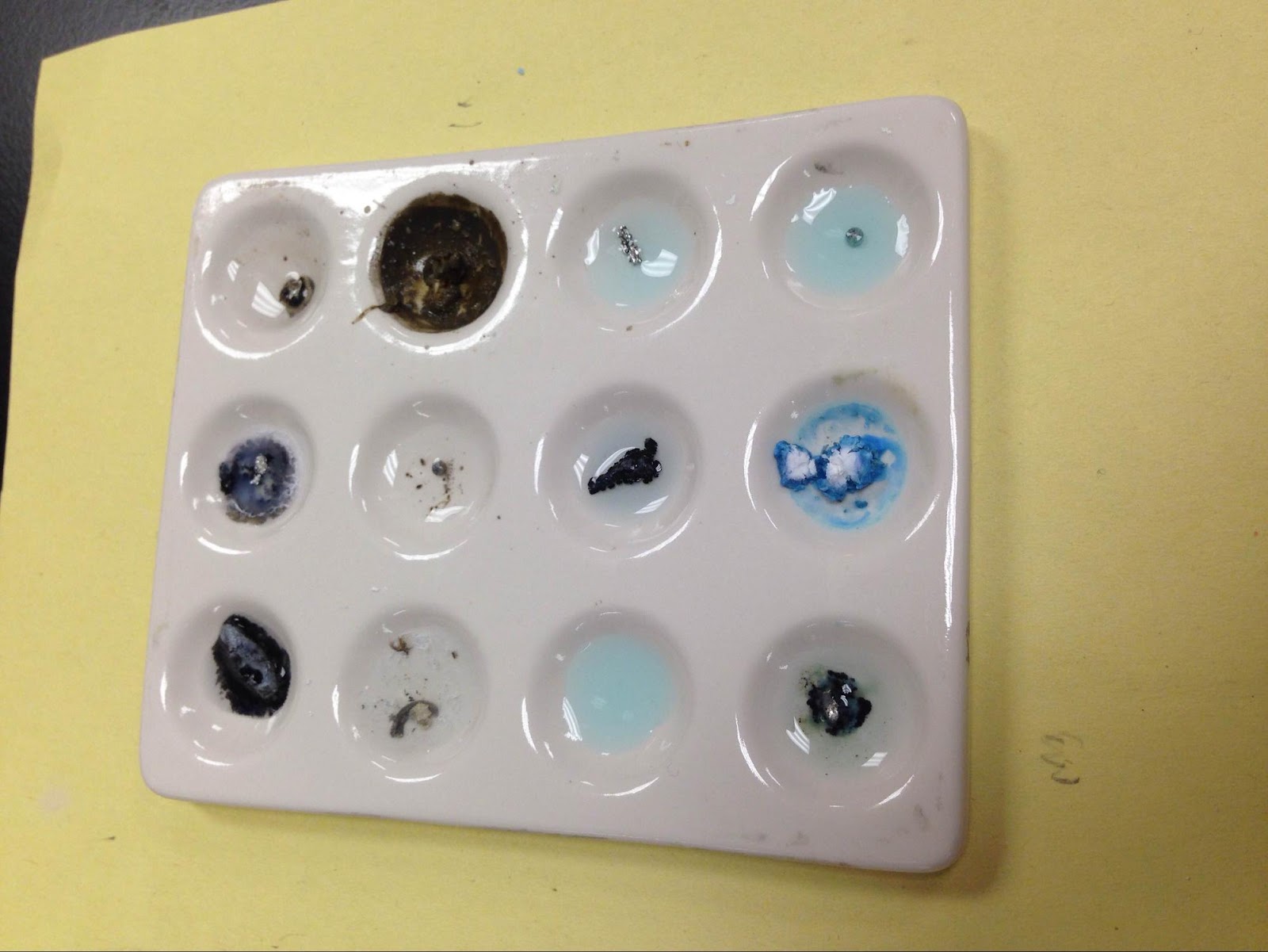
Chemical Reactions Lab
In class, we were able to perform a chemical reactions lab in order to determine the reactivity series of the different elements. After determining the reactivity series for the different metals, we calculated the net ionic equations of the reactions that occurred during the lab. The reactivity series goes from the most reactive on the top, to the least reactive on the bottom. Those that are higher up on the reactivity series react more with other metals; whereas, those on the bottom react with less metals.
Monday, November 30, 2015
Acid Base Reactions
Acid-base reactions are reactions that form water as a product. The water that is formed as a product is the driving force of these reactions. Along with the production of water, acid-base reactions also produce a "salt", a cation of the base and anion of the acid.
In acid-base reactions, strong acids will produce H+ as a product. Strong acids can also be determined by looking at whether it is HCL, HBr, HI, or if the oxygen's outnumber the hydrogen's by two or more.
Strong bases contain a hydroxide (OH-) anion in the reactants of an acid-base reaction. When any Group 1 or Group 2 metals are with the OH- anion, it is a strong base.
However, when there is a weak acid or base in an acid-base reaction, the weak acid will not protonate completely and the weak base won't completely.
This is helpful in studying characteristics of strong acids and bases
I found this video to be helpful
In acid-base reactions, strong acids will produce H+ as a product. Strong acids can also be determined by looking at whether it is HCL, HBr, HI, or if the oxygen's outnumber the hydrogen's by two or more.
Strong bases contain a hydroxide (OH-) anion in the reactants of an acid-base reaction. When any Group 1 or Group 2 metals are with the OH- anion, it is a strong base.
However, when there is a weak acid or base in an acid-base reaction, the weak acid will not protonate completely and the weak base won't completely.
This is helpful in studying characteristics of strong acids and bases
I found this video to be helpful
Saturday, November 28, 2015
Solubility Rules Lab
The solubility rule lab was performed today in class in order to see how solubility rules affect the different chemical reactions. Using the solubility rules, we predicted which chemicals would cause a reaction when they were placed into the wells together. In the pictures below, there is the list of solubility rules and some of the chemical reactions that took place.
This quiz is helpful in practicing using solubility rules


Monday, November 23, 2015
Double replacement reactions
The first set of class notes for this unit were over double replacement reactions.
A double replacement reaction is when two compounds react together to form two new compounds. In these reactions, the positive ions replace each other.
The general formula for double replacement reactions is: AB + CD → AD + CB
Double replacement reactions have four different driving forces:
- Formation of gas
- Formation of water
- Formation of a solid
- Transfer of electrons
Subscribe to:
Posts (Atom)