Make Your Own Biodiesel
Monday, April 11, 2016
Making Biodiesel
After learning about biodiesel for our biodiesel videos we made biodiesel in a lab. We made the biodiesel using Chick-Fil-La sauce by mixing our oil and base together on a hot plate. After the oil and base had mixed for 25 minutes we removed it and poured it into a plastic cup. The cloudy brown color that formed after mixing ended up splitting into methyl esters and glycerin. The separated put biodiesel will be used to fuel the pop pop boats we are making next.
Make Your Own Biodiesel


Make Your Own Biodiesel
Monday, April 4, 2016
Biodiesel Video
In this unit we learned about an alternative source for gas called biodiesel. This alternative fuel has many health benefits over the normal diesel gas that is used to fuel our trucks. These benefits include
To learn more about biodiesel you can watch this video my lab partner and I made: YouTube.
Some links that were helpful in making this video included the following:
http://biodiesel.org/
https://www.fueleconomy.gov/feg/biodiesel.shtml
http://www.afdc.energy.gov/fuels/biodiesel_benefits.html
To learn more about biodiesel you can watch this video my lab partner and I made: YouTube.
Some links that were helpful in making this video included the following:
http://biodiesel.org/
https://www.fueleconomy.gov/feg/biodiesel.shtml
http://www.afdc.energy.gov/fuels/biodiesel_benefits.html
Monday, March 14, 2016
Polarity and Bonds
Today's lesson was over bond polarity and different types of bonds. Polarity occurs when electrons aren't shared equally between two atoms. When the electrons are shared unequally, one electron has a stronger pull on the bond as a result of differing electronegativities. Between the electrons in an atom, one of three different types of bonds forms: nonpolar covalent, polar covalent, or ionic. Nonpolar covalent occurs when the two electrons are shared equally between the atoms. Polar covalent is the result of unequally shared electrons that cause a partial charge on the atoms. Lastly, ionic bonds are formed when a complete transfer of electrons occurs giving full charges on the resulting ions.

Polarity practice
Polarity
Polarity practice
Polarity
Wednesday, March 9, 2016
Shape of Molecules
The valence shell electron pair repulsion theory is what is used in order to predict the shape of a molecule. The number of lone pairs and bonded entities present in a molecule will determine it's shape. In particular, we focused on five of the molecular shapes: linear, bent, tetrahedral, trigonal planar, and triganol pyrimidal. A linear molecule has a central atom, consisting of no lone pairs, with two bonded entities. Bent molecules also have two bonded entities but the central atom has two lone pairs. A tetrahedral shaped molecules consists of a central atom with four bonded entities. A molecule without lone pairs on the central atom and three bonded entities is trigonal planar. Lastly, a molecule that is trigonal pyrimidal contains a central atom with two lone pairs and three bonded entities.

We also went over resonance in this lecture. Resonance occurs when a molecule has multiple bonds that can be moved throughout the molecule with the same resulting charges. The picture below shows resonance occurring in an NO3 molecule. Resonance equalizes both the bond strength and the bond length throughout the molecule.

Molecular Shapes Practice
resonance practice
We also went over resonance in this lecture. Resonance occurs when a molecule has multiple bonds that can be moved throughout the molecule with the same resulting charges. The picture below shows resonance occurring in an NO3 molecule. Resonance equalizes both the bond strength and the bond length throughout the molecule.
Molecular Shapes Practice
resonance practice
Tuesday, March 8, 2016
Lewis Dot Structures
In today's lecture we learned about Lewis Dot Concept that help to show the chemical bonding occurring within a molecule. In order to make a Lewis Dot Concept, a dot must be placed around the element to represent each electron in its valence shell. The dots must be placed going clockwise and only pairing up once four electrons has been exceeded.

One of the rules we learned regarding electrons in the valence shell was the octet rule. The octet rule states that, with a few exceptions, an atom can not have more than eight electrons in it's outer shell. An example of an exception is beryllium. Beryllium, despite the predicted four valence electron, requires six valence electrons in order to be stable.

Practice
Lewis Dot Structures
One of the rules we learned regarding electrons in the valence shell was the octet rule. The octet rule states that, with a few exceptions, an atom can not have more than eight electrons in it's outer shell. An example of an exception is beryllium. Beryllium, despite the predicted four valence electron, requires six valence electrons in order to be stable.
Practice
Lewis Dot Structures
Tuesday, March 1, 2016
Periodic Trends
In class today we learned about four different periodic trends. The first periodic trend we learned was atomic size. As you move down a group, the atoms tend to get larger, and as you move across a period from left to right, the atomic size decreases. The first part of this trend occurs because electrons are being added to larger orbitals. The second part of this trend is due to the fact that we are adding protons without much of an increase in shielding. With more protons being added, the nuclear charge becomes greater causing orbiting electrons to pull more toward the nucleus.

The next periodic trend we learned was over ionization energy. Ionization energy is the energy needed to remove an electron from a gaseous atom. When this electron is removed from the gaseous ion it results in the formation of a cation. Ionization energy occurs each time an electron is removed, meaning their are multiple sets of ionization energies. For this trend, the ionization energy increases as you move up and to the right across the periodic table.
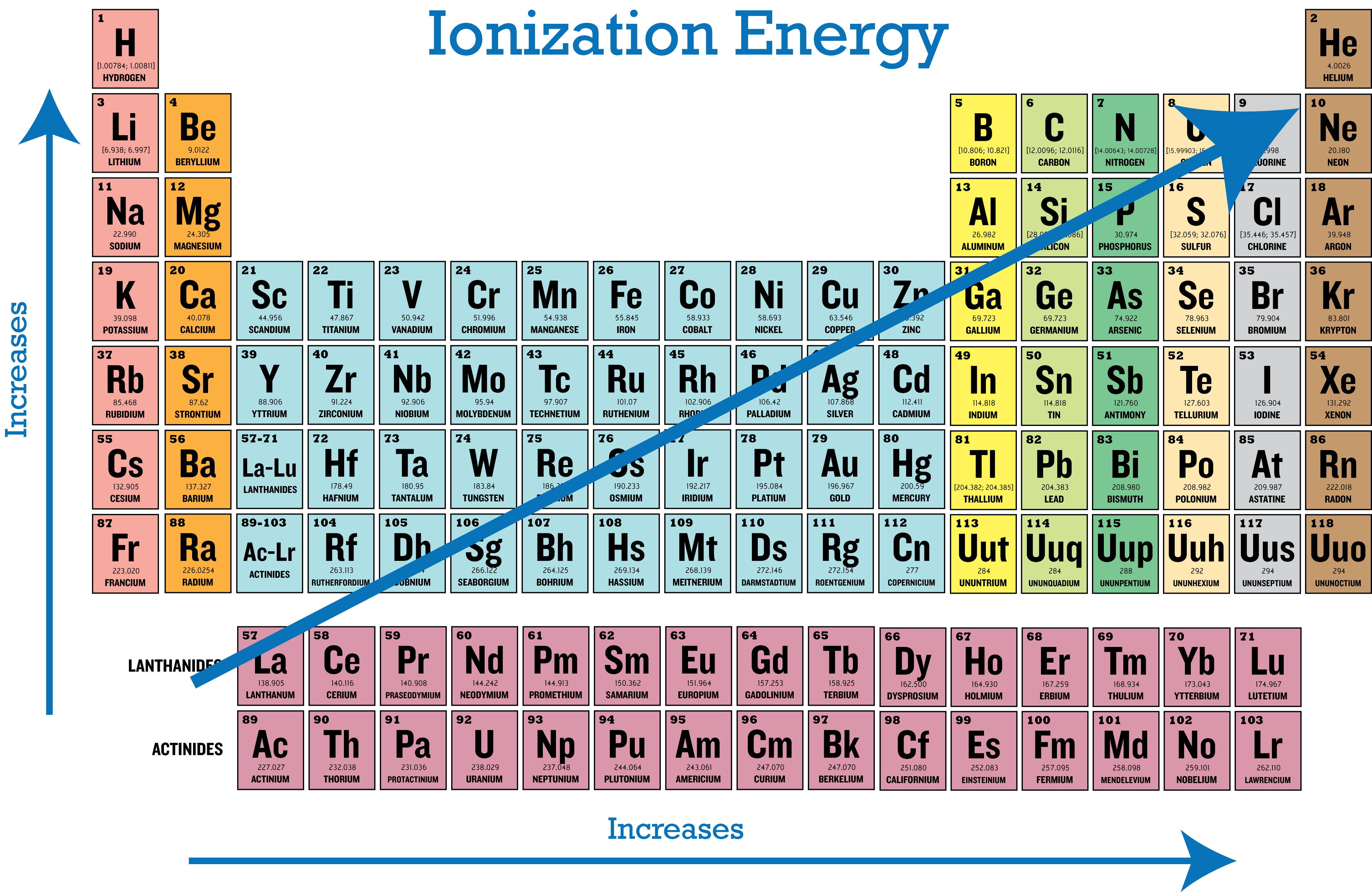
Electron affinity was the next periodic trend we went over in class. Electron affinity is known as the ease with which an electron may be added to an atom, forming an anion. Since some atoms give off energy when an electron is added, some electron affinities are negative. The periodic trend for electron affinity is an increase as you move up and to the right on the periodic table.

The last periodic trend we learned in this lecture was on electronegativity. Electronegativity is the tendency of an atom to draw electrons toward itself when it's chemically combined with another element. An important thing to remember about electronegativity is that there are no units of measurement. The relative trend for electronegativity is an increase as you move up and to the right on the periodic table, excluding noble gases.

http://chemwiki.ucdavis.edu/Core/Inorganic_Chemistry/Descriptive_Chemistry/Periodic_Trends_of_Elemental_Properties/Periodic_Trends
The next periodic trend we learned was over ionization energy. Ionization energy is the energy needed to remove an electron from a gaseous atom. When this electron is removed from the gaseous ion it results in the formation of a cation. Ionization energy occurs each time an electron is removed, meaning their are multiple sets of ionization energies. For this trend, the ionization energy increases as you move up and to the right across the periodic table.
Electron affinity was the next periodic trend we went over in class. Electron affinity is known as the ease with which an electron may be added to an atom, forming an anion. Since some atoms give off energy when an electron is added, some electron affinities are negative. The periodic trend for electron affinity is an increase as you move up and to the right on the periodic table.
The last periodic trend we learned in this lecture was on electronegativity. Electronegativity is the tendency of an atom to draw electrons toward itself when it's chemically combined with another element. An important thing to remember about electronegativity is that there are no units of measurement. The relative trend for electronegativity is an increase as you move up and to the right on the periodic table, excluding noble gases.
http://chemwiki.ucdavis.edu/Core/Inorganic_Chemistry/Descriptive_Chemistry/Periodic_Trends_of_Elemental_Properties/Periodic_Trends
Monday, February 29, 2016
Quantum Numbers
Today in class we learned about quantum numbers. Every set of quantum numbers contains four numbers that represent different values.
- The first quantum number is the value of the principal energy level, labeled as n
- The second quantum number is the number that determines the type of sublevel, labeled as l
- The third quantum number runs from -1 to +1, labeled as ml
- The fourth, and last, quantum number is spin of the electrons, labeled as ms
Subscribe to:
Posts (Atom)